
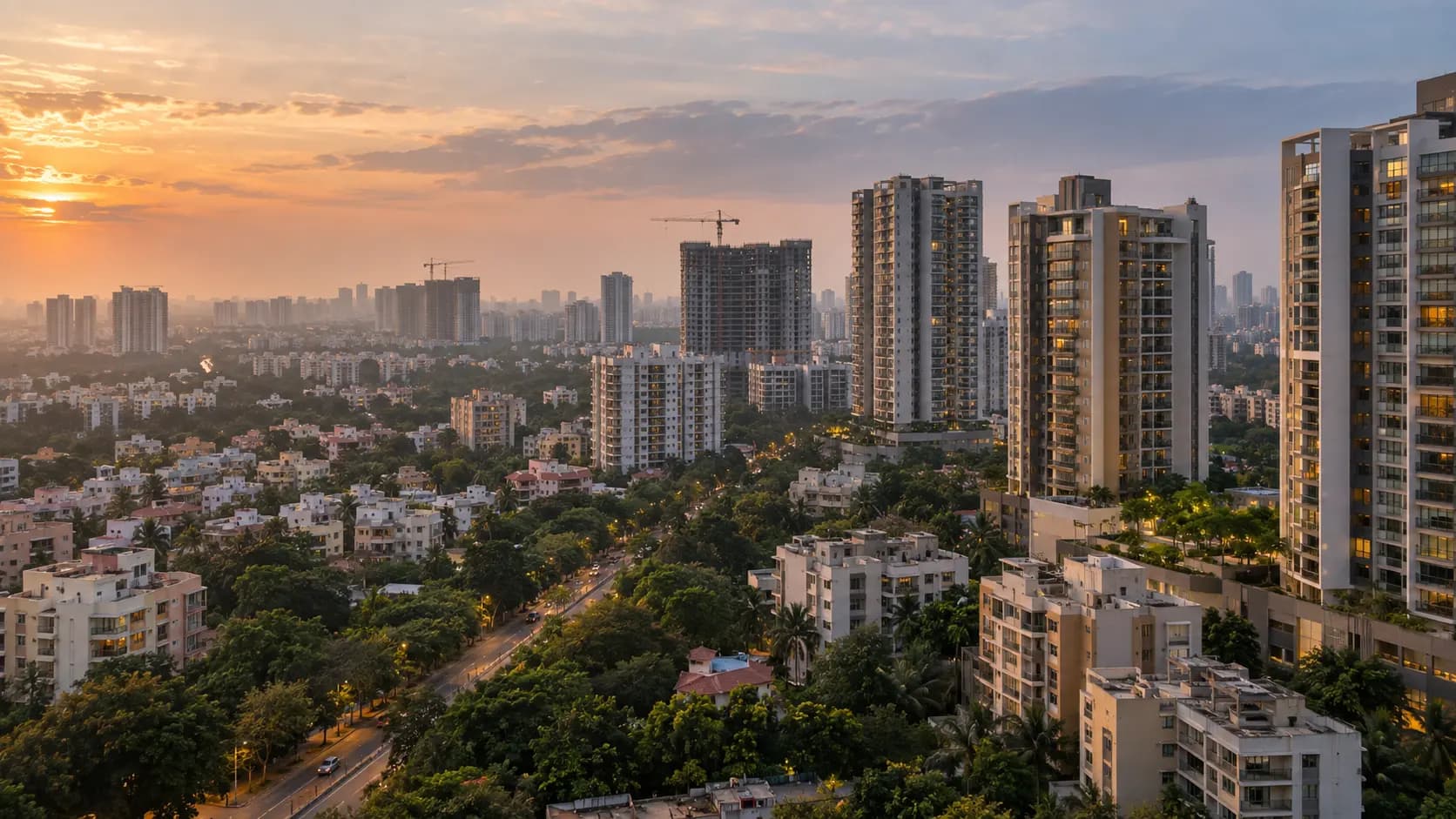
India’s residential market is still selling homes at scale, but the growth story is becoming more selective. Data published for the first half of 2026 shows premium housing taking a larger share of transactions while lower-ticket supply and sales lose ground. Bengaluru illustrates the tension clearly: the city’s residential demand moderated in the second quarter even as prices and rents continued to rise.
Premium homes now carry more of the national market
The latest H1 2026 figures reported from Knight Frank India show 171,471 homes sold across eight major cities, roughly 1% more than in H1 2025. Developers launched 187,350 homes, up 4% year on year. The headline is resilience, but the mix underneath it is changing.
Homes priced above ₹1 crore accounted for 54% of sales in H1 2026, up from 49% a year earlier. The sub-₹50 lakh segment moved in the opposite direction: sales fell 15% to 32,063 homes and represented 19% of the total. The ₹1 crore–₹2 crore band was the largest single ticket-size category, contributing 29% of sales.
That shift is also visible in CREDAI–Liases Foras’ review of 2025. The primary builders’ market recorded approximately ₹8.46 lakh crore in sales value, up 16% from 2024, while homes priced above ₹1 crore contributed 78% of total sales value. The figures do not mean every city or project is performing alike; they show that higher-value transactions are doing more of the work in the aggregate market.
Bengaluru shows why volume and price need to be read together
JLL’s Bengaluru Mass Residential Market Dynamics Q2 2026 reported demand of approximately 17,000 units, down 6% quarter on quarter. New residential launches fell 20% from the previous quarter. At the same time, overall property prices rose 3.1% and rents rose 2.5% quarter on quarter.
This combination is important for readers who use price movement as a shortcut for market health. A city can post higher prices while transaction momentum becomes more measured. The two signals are not contradictory: they can reflect a mix of premium launches, established employment corridors, limited availability in preferred locations and a slower decision cycle among buyers.
Bengaluru’s employment base remains a major support. JLL’s India Office Market Dynamics Q2 2026 report said Bengaluru accounted for 30.9% of India’s H1 2026 office net absorption, while the city led Q2 net absorption with a 25.5% share. That commercial demand helps explain why residential pricing has not simply followed the quarter’s softer sales pace, but it does not remove the need to check a project’s own inventory, delivery record and micro-market demand.

What buyers and developers should watch next
For buyers, the national premiumisation headline is not a substitute for a project-level comparison. The useful questions are narrower: what ticket-size segment is being launched, how much comparable inventory is unsold, how quickly similar homes are being absorbed, and whether the location’s employment and transport drivers are already operating rather than only proposed?
For developers, the data points to a balancing act. Premium demand remains available, but rising launches and a cooling quarter in Bengaluru make product-market fit and execution more important. New supply that is priced beyond the local buyer pool may need a longer sales cycle even when citywide prices remain firm.
The broader signal is therefore neither a blanket boom nor a broad correction. India’s housing market is moving into a more segmented phase: premium homes continue to attract demand and value, while affordability, inventory and local absorption deserve closer scrutiny.
Source disclosure
This article is based on the following dated market reports and coverage retrieved on 22 September 2026:
- Financial Express report on Knight Frank India’s H1 2026 housing data
- JLL Bengaluru Mass Residential Market Dynamics Q2 2026
- JLL India Office Market Dynamics Q2 2026
- CREDAI–Liases Foras Indian Real Estate CY 2025 report summary
The visuals are original conceptual images generated for this article. They are representative editorial imagery, not photographs of a named project, official market charts or government documents.