
ET Realty has published an interview with Prashant Parmar, founder and principal architect at Shayona Consultant, on how artificial intelligence, social media and global visual references are changing architecture and interior-design expectations.
The interview places AI inside a broader shift in how clients discover design ideas. ET Realty’s description says wider digital exposure has given clients access to materials, styles and references from around the world. Parmar’s central caution is that visual access does not remove the constraints of a real project.
What Parmar said about AI and design expectations
According to ET Realty’s account of the interview, Parmar said AI-generated designs can create unrealistic expectations. The concern is not presented as a rejection of technology. It is a warning that an image can appear convincing without demonstrating whether the depicted design is appropriate for a particular site, client or budget.
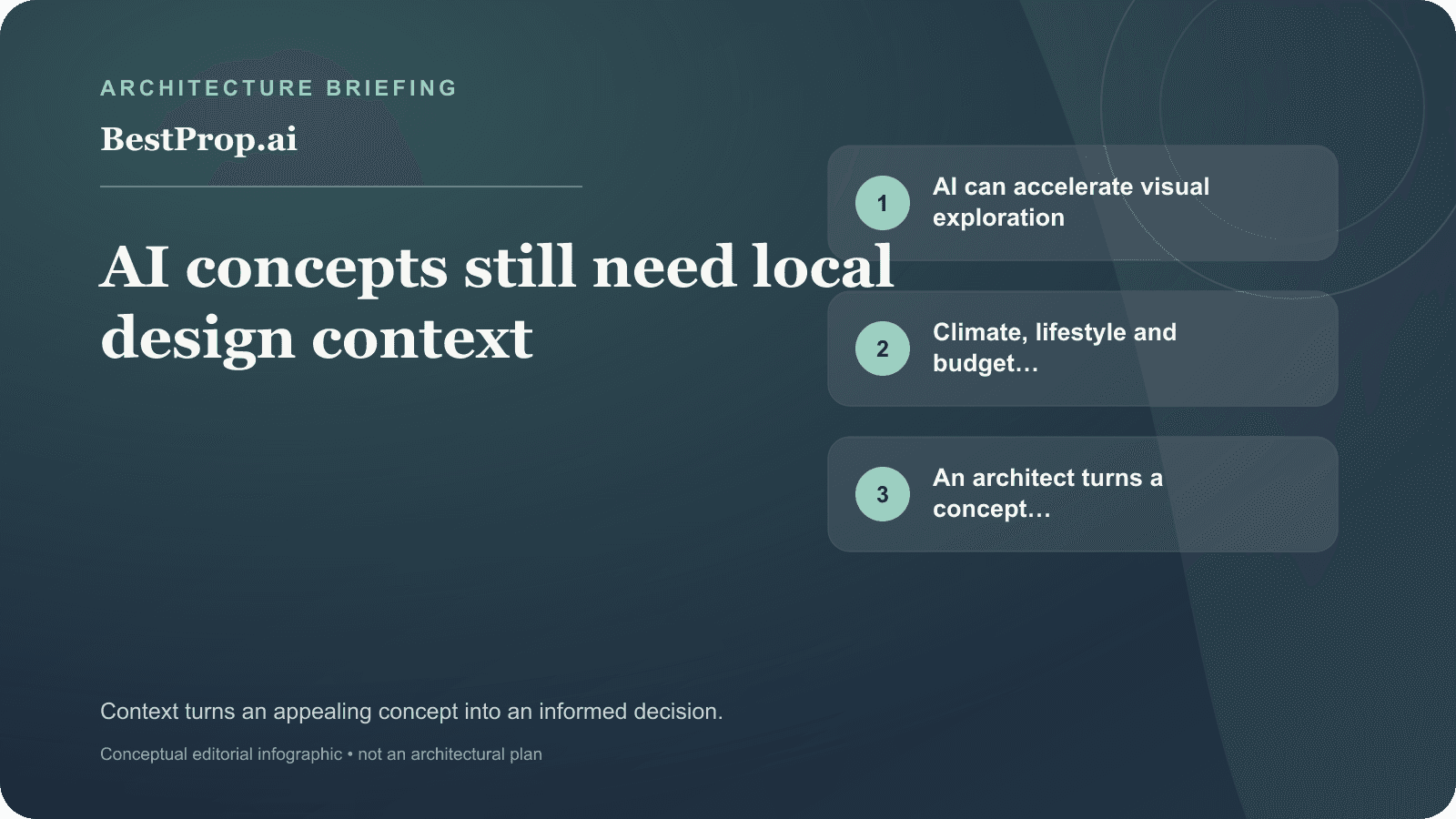
Parmar said design still needs to be rooted in local context, client requirements, climate, lifestyle and budget. That position makes a distinction between visual exploration and professional design resolution: a reference can influence direction, while the finished design still depends on project-specific conditions.
ET Realty also says the discussion covered homeowners attempting to reproduce global lifestyles inside Indian homes even when those ideas may not be practical for Indian conditions. Parmar linked the challenge to the growing volume of international imagery available through social platforms and other digital tools.
Why local context remains part of the design decision
The interview’s emphasis on context identifies several variables that an image alone cannot settle. Climate affects material and envelope choices. Lifestyle affects circulation, storage and everyday use. A client’s budget affects which finishes and construction methods remain viable. Local conditions also influence how a design is detailed and maintained.
In Parmar’s framing, technology expands the set of ideas available to architects and clients, but it does not make those variables disappear. The architect’s role therefore includes interpreting a visual preference and adapting it to the actual project rather than reproducing the image without modification.
The discussion also connects AI with a longer-running change in client behaviour. International travel and social media had already exposed homeowners to global design references before generative tools became widely available. AI increases the speed and volume at which new combinations can be produced, intensifying the gap between an immediately generated image and a fully resolved proposal.
What the interview establishes—and what it does not
The ET Realty video records an architect’s professional assessment of changing client expectations and design practice. It establishes Parmar’s view that AI is useful within a process but can mislead when an attractive output is treated as proof of feasibility.
It does not establish that every AI-assisted design is impractical, nor does it compare particular software products or quantify how frequently generated proposals fail. The interview is better read as a practice warning: generated imagery may be persuasive before site, climate, lifestyle and cost constraints have been resolved.
That distinction matters as AI tools become more visible in property marketing and early-stage design conversations. The source supports a bounded conclusion: AI can broaden visual exploration, while responsibility for a workable design remains tied to project-specific professional judgment.
Source Disclosure
- Source video: AI-generated designs can create unrealistic expectations: Prashant Parmar
- Channel: ET Realty
- Retrieved: 2026-09-17T14:21:50.868Z
- Attribution basis: official YouTube embed/source URL with Veritas-authored commentary; no copied captions or transcript text.